

April 22, 2026
Hedge Funds, Claude, MCP, Skill/10 minutes read
Share buybacks are one of the most persistent and underexploited flow signals in equity markets. For hedge funds, the edge is not just knowing that a company authorized a repurchase, it is knowing when the flow is likely to hit the tape, how long it can persist, and what changes when that bid disappears.
With Claude, Bigdata MCP, and the Bigdata plugin, your team can move from manual monitoring to a repeatable, research-grade workflow that detects buyback events early, tracks execution, and translates disclosure data into tradable insight.
Buyback intelligence for hedge funds
When a company is actively repurchasing shares, it often acts as a large, price-insensitive buyer. That can support price action, compress realized volatility, and create a measurable tailwind for positioning. When the company enters blackout, that structural bid may fade and relative performance can shift quickly. That is why high-performing event and fundamental teams track three things together:- Announcement and authorization signals from 8-K filings and press releases.
- Execution follow-through from 10-Q/10-K repurchase tables and related disclosures.
- Calendar position across open windows, blackout periods, and 10b5-1 plan activity.
Build this workflow in minutes
You can replicate this process today with three components:- Connect Claude to the official Bigdata connector: Bigdata Connector for Claude
- Install the Bigdata plugin with the financial skills:
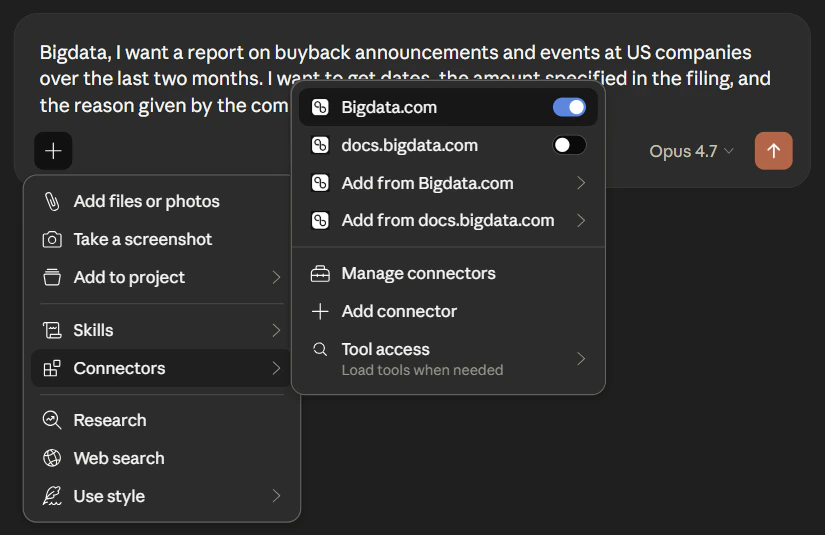
Examples
- Last two months analysis
- General US Buyback announcements analysis
Buybacks dates are critical
Trading windows and blackout periods shape supply-demand dynamics. Companies cannot repurchase shares at any time. Their activity is constrained by policy, regulation, and disclosure practices:- Blackout periods: often the last ~4 weeks of a quarter through 1-2 days after earnings, when companies typically stop discretionary repurchases.
- Open windows: the post-earnings period where open-market buybacks can resume.
- Rule 10b5-1 plans (US): pre-arranged plans that may allow continued purchases during blackout windows.
- SEC Rule 10b-18 safe harbor: practical limits on timing, price, and daily volume of repurchases.
- Flow prediction: open windows can add a steady corporate bid; blackout can remove it.
- Event-driven entries/exits: announcement dates and window re-openings can create tactical opportunities.
- ASR impact modeling: accelerated share repurchases can reduce float quickly and shift microstructure.
- Valuation and capital-structure analysis: buybacks influence EPS, leverage, and payout mix.
Announcement date vs execution date
1. Announcement / authorization date
This is when the board authorizes repurchases up to a notional amount over a time horizon. It is a signal of intent, not guaranteed execution. It often communicates:- perceived undervaluation,
- excess capital and return-of-capital preference,
- dilution offset goals,
- confidence in medium-term fundamentals.
2. Execution dates and pace
This is where conviction becomes observable behavior. Actual execution data reveals:- whether management follows through,
- the pace and price levels of buying,
- how much authorization remains as future support.
Data sources in the US
- 8-K filings: common source for initial authorization announcements.
- 10-Q and 10-K filings: quarterly repurchase tables with shares bought, average price, and remaining authorization.
- Press releases and IR pages: often the earliest public disclosure channel.
- Form 4 filings: insider activity context (indirectly relevant for broader signal interpretation).
Why Claude + Bigdata + Skills
Traditional desks lose time stitching these data points manually across filings, news, and calendars. The Bigdata plugin with financial skills gives Claude a repeatable research framework, while Bigdata MCP provides the data and retrieval layer required for timely, attribution-backed outputs. The result is faster generation of consistent buyback intelligence, with less operational drag and more time spent on actual portfolio decisions.Production pipeline
Once your team defines the flow and prompt template, you can automate the same process programmatically using the Claude SDK or any other LLM model/agentic host that supports MCP. With a Bigdata API key, the workflow can run on a schedule and feed directly into internal dashboards, alerting systems, or morning risk packets, with consistent structure across every report. To set this up, follow the MCP API-key integration guide: MCP Integration with API Key.
Oscar Sanchez Iglesias
Senior Product Manager