

October 21, 2026
MCP, Watchlists, Thematic Research/6 minutes read
Robotics is no longer one industry. It runs from warehouse shuttles and factory arms to surgical robots, self-driving trucks and humanoids, and the companies behind it are listed in New York, Tokyo, Seoul, Shenzhen and across Europe. Building a coverage list for that theme usually means a screener, a spreadsheet and a lot of copy and paste.
This post walks through the same job with four tools from the Bigdata MCP. We go from a cross-market screen to a saved watchlist, a portfolio grid with charts, and one search that covers all 49 companies at once. Then we go deeper on a single name.
| Step | Tool | What it does |
|---|---|---|
| 1 | bigdata_screen_companies | Finds listed companies by country, industry and market cap |
| 2 | bigdata_create_watchlist | Saves the selected companies as a reusable watchlist |
| 3 | bigdata_portfolio_tearsheet | Returns price, EPS, analyst targets and market cap for every company in one grid |
| 4 | bigdata_watchlist_search | Runs one query across the whole watchlist, with results grouped by company |
| + | bigdata_search | Goes deeper on a single company |
Step 1: Screen 13 markets for robotics companies
The theme covers five areas: warehouse, factory, medical, self-driving and humanoid robots, plus the chip and software platforms they run on. Aerospace and defense are out of scope. There is no “Robotics” industry in the screener, so we map the theme to eight industries:
We screen 13 countries: the US, Germany, France, the Netherlands, Spain, the UK, Switzerland, Sweden, Israel, Japan, South Korea, China and Hong Kong. Market cap is filtered in each listing’s own currency, so the threshold of about $5 billion is set per currency: USD 5bn, EUR 4.3bn, GBP 3.7bn, CHF 4bn, SEK 47bn, JPY 750bn, KRW 7tn, CNY 36bn, HKD 39bn and ILS 18bn.
Copy this prompt into your agent:
bigdata_screen_companies once per country and industry. Across all of them the screen returns 391 companies. Most of them build pumps, HVAC systems or memory chips, so we keep the 49 with clear robotics exposure:
Step 2: Save the companies as a watchlist
In the same conversation, ask the agent to save the list:bigdata_create_watchlist and confirms the new watchlist with its ID:

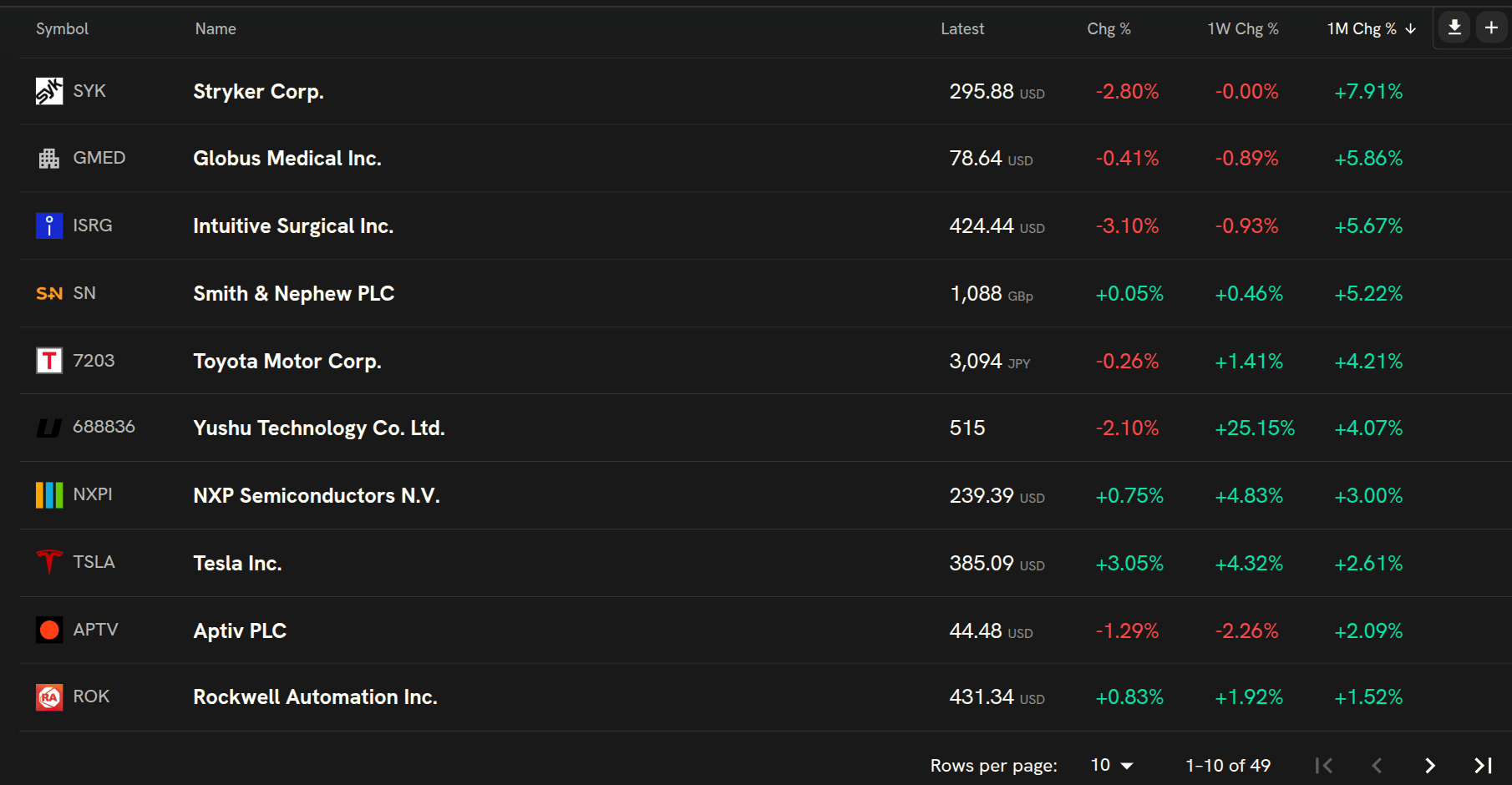
Step 3: Compare the companies in one grid
Ask for a portfolio view and the two charts:bigdata_portfolio_tearsheet, which returns one row per company with the metrics you ask for.
Consensus EPS for the last reported quarter
EPS is reported in each company’s own currency, so we compare companies within one currency at a time.- USD
- JPY
- KRW
- CNY
- EUR
- SEK


Consensus price target compared with today’s price
For the companies with analyst price targets, the gap between the consensus target and the current price shows where analysts see the most room to rise. Arm, NVIDIA and Mobileye lead the list.
Step 4: Search every company at once
bigdata_watchlist_search runs one query across the whole list and returns results grouped by company. Every company gets its own share of the results, so the most covered names cannot crowd out the rest.
Ask one question per prompt. The first covers patents:
- Patents
- Products
Going deeper: Symbotic
The watchlist search gives a line per company. When one name stands out,bigdata_search goes deeper into its filings, transcripts and news. Again, one question per prompt:
- The problem. Manual warehouse work is becoming unsustainable as labor shifts, wages rise and e-commerce adds complexity, and older automation cannot keep up (10-Q).
- The product. An AI-powered robotic system that moves, stores and sorts cases and individual items in high-density warehouses for Walmart, C&S Wholesale Grocers and Exol, its warehouse-as-a-service joint venture (Q3 FY2026 report).
- What’s new. The acquisition of cellumation adds the celluveyor, a surface of independently controlled cells that sorts products without conveyor belts, for more throughput in less space (press release).
- The patents. About 1,100 issued or pending patents, more than 650 of them issued, backed by more than $1 billion of cumulative R&D (10-Q, 8-K).
- The scale. A backlog of about $22.5 billion and Q3 FY2026 revenue up 21.7% year on year to $720.8 million (Nasdaq).
Try it yourself
The whole workflow runs from any MCP client connected to Bigdata, such as Claude. Ask it to screen, save, compare and search in plain language, and it chains the tools for you.Connect the Bigdata MCP
Set up the Bigdata MCP in your AI client.
Screen companies
See every filter the screener accepts.

Oscar Sanchez Iglesias
Senior Product Manager